


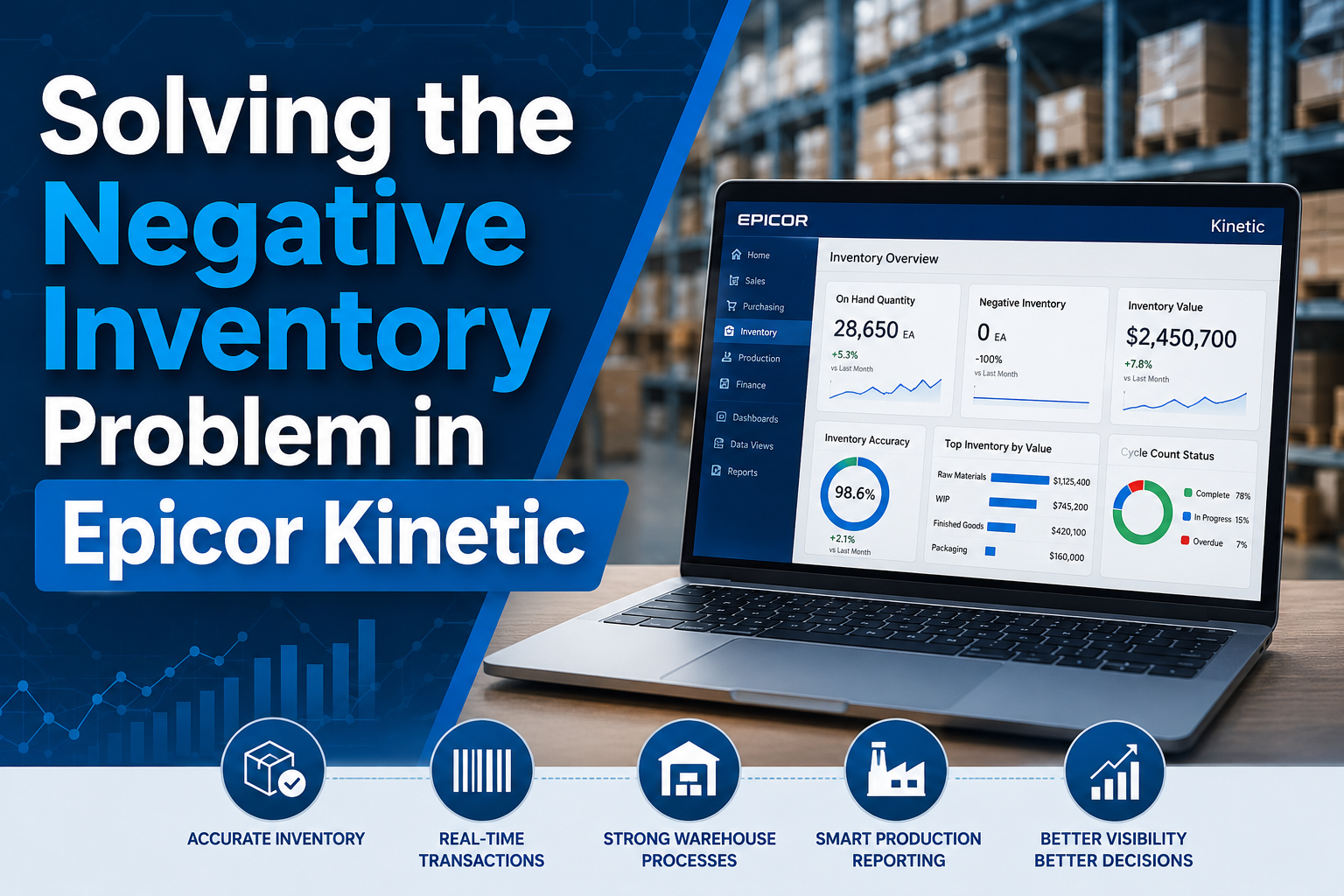
21 May Solving the Negative Inventory Problem in Epicor Kinetic
Solving the Negative Inventory Problem in Epicor Kinetic
Negative inventory in Epicor Kinetic creates operational confusion across manufacturing, warehousing, purchasing, and finance. Buyers reorder materials that already exist. Production teams stop jobs because inventory appears unavailable. Warehouse employees lose trust in ERP inventory balances.
This article explains how businesses can eliminate negative inventory problems in Epicor Kinetic through better warehouse discipline, stronger ERP controls, accurate production reporting, and real-time inventory visibility.
This guide shows manufacturers and distributors how to improve inventory accuracy, reduce costing errors, strengthen operational control, and create reliable inventory management processes.
- Improve inventory accuracy across warehouse and production operations
- Reduce purchasing mistakes caused by incorrect stock balances
- Prevent shipping delays and production interruptions
- Strengthen financial reporting and inventory valuation accuracy
- Build better warehouse discipline using Epicor Kinetic tools
Why Negative Inventory Happens in Epicor Kinetic
Negative inventory in Epicor Kinetic reduces inventory accuracy and creates operational risk across purchasing, warehousing, production, and finance. Businesses that understand the root causes can eliminate recurring inventory discrepancies before they impact customer orders and profitability.
Many manufacturers assume negative inventory comes from a system problem. In most cases, the issue starts with inconsistent operational processes, delayed ERP transactions, or poor inventory discipline. Epicor Kinetic records inventory activity based on real-time transactions. When users skip steps, delay reporting, or process transactions out of sequence, inventory balances become unreliable.
Delayed Transaction Posting in Epicor Kinetic
Delayed transaction posting in Epicor Kinetic creates inventory timing gaps that lead to inaccurate stock balances. Warehouse and production teams often move materials physically before recording transactions inside the ERP system.
Common delayed posting scenarios include:
- Late material issue reporting
- Delayed receiving transactions
- Shipping confirmation delays
- Manual paperwork entered after production completion
- Offline warehouse processes without barcode scanning
Businesses reduce these problems by enforcing real-time transaction processing. Barcode scanners, mobile warehouse devices, and automated workflows improve transaction speed and inventory visibility.
Warehouse Process Gaps That Create Negative Inventory
Warehouse process gaps in Epicor Kinetic increase inventory errors and reduce operational control. Many negative inventory problems originate from inconsistent warehouse procedures rather than ERP configuration failures.
Several warehouse process failures contribute to negative inventory:
- Incorrect bin transfers
- Unrecorded inventory moves
- Picking inventory from the wrong warehouse location
- Duplicate transaction entries
- Skipped cycle counts
- Inaccurate unit-of-measure conversions
Strong warehouse discipline prevents these issues. Standard operating procedures, warehouse audits, and barcode validation improve inventory consistency.
Production Reporting Errors and Timing Issues
Production reporting errors in Epicor Kinetic create inventory discrepancies between manufacturing activity and ERP inventory balances. Manufacturers with high production volume often experience timing conflicts between shop floor activity and system reporting.
Several manufacturing activities commonly trigger negative inventory:
- Backflushing material before inventory receipt completion
- Reporting finished goods before raw material issues
- Consuming substitute materials without ERP updates
- Delayed labor and production reporting
- Incorrect bill of material quantities
Manufacturers improve accuracy by reviewing bill of material structures regularly and validating production reporting procedures on the shop floor.
Multi-Warehouse Inventory Synchronization Problems
Multi-warehouse operations in Epicor Kinetic increase inventory complexity and create synchronization challenges. Businesses operating across multiple facilities often struggle with inventory timing and transfer accuracy.
Companies reduce synchronization issues by implementing:
- Automated transfer workflows
- Real-time warehouse scanning
- Standardized transfer approval procedures
- Inventory reconciliation reporting
- Centralized inventory visibility dashboards
How Negative Inventory Impacts Manufacturing and Distribution Operations
Negative inventory in Epicor Kinetic disrupts manufacturing operations, weakens inventory planning, and increases financial risk across the business. Companies that ignore inventory accuracy problems often experience production delays, purchasing mistakes, customer service issues, and unreliable reporting.
Purchasing Errors Caused by Incorrect Inventory Data
Negative inventory in Epicor Kinetic causes purchasing teams to make incorrect buying decisions. Buyers rely on ERP inventory balances to determine replenishment quantities, supplier schedules, and safety stock levels.
- Duplicate purchasing orders
- Expedited freight costs
- Excess safety stock
- Supplier schedule disruptions
- Overstocked inventory
- Material shortages during production
Production Downtime from Inventory Inaccuracy
Production downtime caused by negative inventory reduces manufacturing efficiency and increases operational costs. Manufacturing teams depend on accurate ERP inventory data to schedule jobs, allocate materials, and maintain production flow.
- Delayed job releases
- Machine downtime
- Emergency material substitutions
- Incomplete production orders
- Increased labor inefficiency
- Manual inventory verification activities
Financial Reporting and Costing Risks
Negative inventory in Epicor Kinetic creates financial reporting risks that impact costing accuracy and business decision-making. Inventory represents a major financial asset for manufacturers and distributors.
- Inventory valuation
- Standard costing
- Average costing calculations
- Gross margin reporting
- Work-in-process valuation
- Financial audits
Customer Service and Shipping Delays
Negative inventory in Epicor Kinetic damages customer service performance by reducing inventory visibility and delaying shipments.
- Late customer shipments
- Partial order fulfillment
- Increased backorders
- Emergency warehouse transfers
- Customer dissatisfaction
- Lost sales opportunities
Conclusion
Solving negative inventory in Epicor Kinetic requires more than correcting inventory balances. Businesses must improve warehouse discipline, strengthen production reporting, optimize ERP configuration, and build standardized operational processes that support accurate inventory management.
Companies that combine strong inventory controls with real-time operational visibility reduce inventory discrepancies, improve financial accuracy, and strengthen customer service performance. Accurate inventory data creates better purchasing decisions, more reliable production scheduling, and faster operational execution across the organization.
Scaled Solutions Group is here to guide you every step of the way.
Call (866) 957-8419
Email info@scaledsolutionsgroup.com
Visit www.Get-Scaled.com