


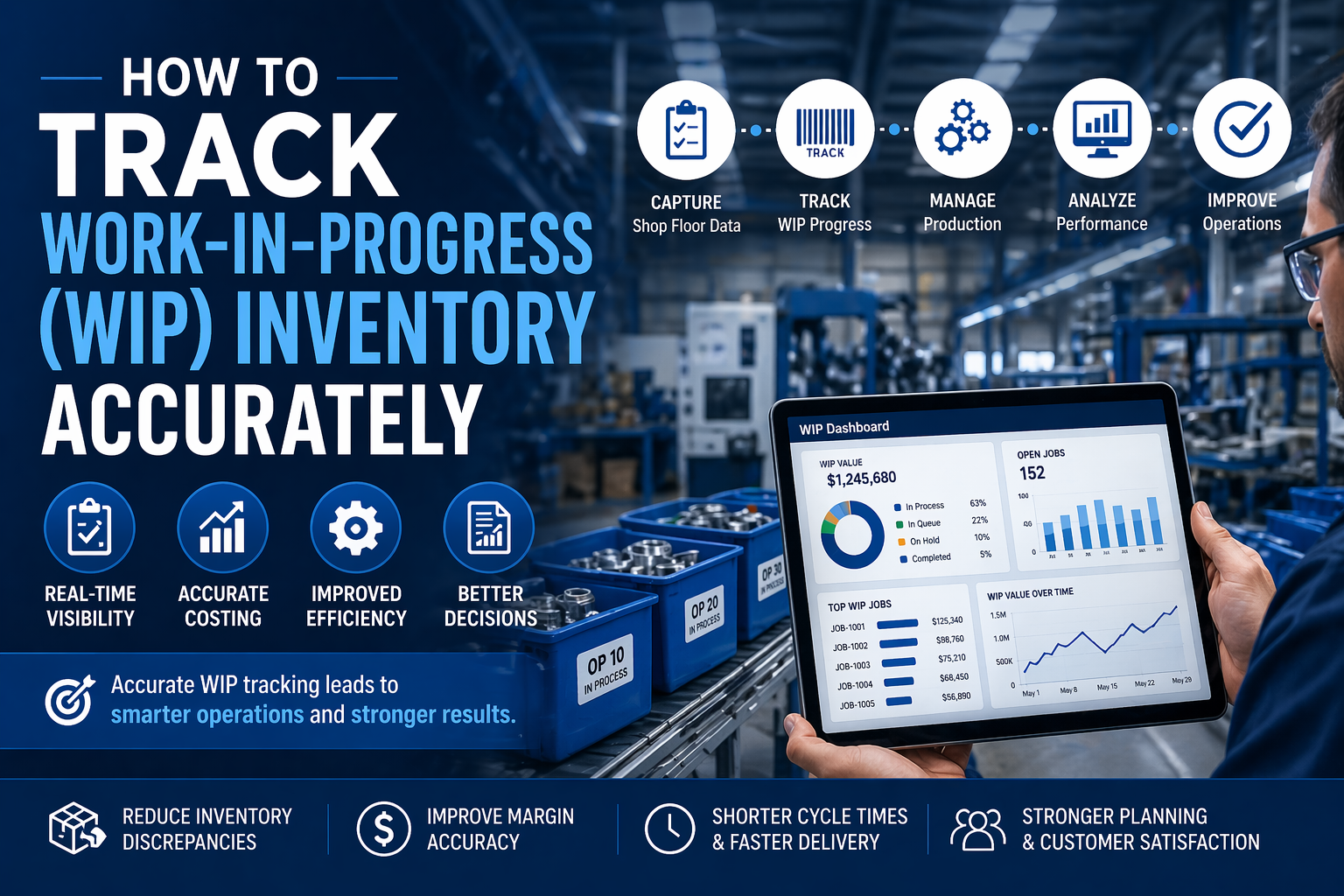
24 Apr How to Track Work-in-Progress (WIP) Inventory Accurately
How to Track Work-in-Progress (WIP) Inventory Accurately
Production teams often struggle to understand the exact status and value of partially completed goods. Without clear visibility, businesses overproduce, delay orders, and misreport inventory costs. These issues create inefficiencies that directly impact profitability and customer satisfaction.
This guide shows how to track Work-in-Progress (WIP) inventory accurately using structured processes, ERP systems, and real-time tracking methods.
- Improve real-time production visibility
- Reduce inventory discrepancies
- Increase cost accuracy for in-process goods
- Enhance production planning
- Enable data-driven decision-making
Work-in-Progress (WIP) Inventory Tracking — What It Is and Why It Matters
Work-in-Progress (WIP) inventory tracking improves production visibility and cost accuracy by showing exactly where materials sit in the production cycle. Businesses that track WIP effectively reduce guesswork and gain control over partially completed goods.
Work-in-progress inventory includes materials, labor, and overhead applied to goods that are not yet finished. Manufacturers, fabricators, and distributors with assembly operations rely on this tracking to understand what is actively in production.
Accurate tracking matters because poor visibility leads to incorrect reporting, delayed fulfillment, and inefficient resource allocation. When teams lack real-time data, they cannot respond quickly to production issues.
Tracking occurs across the shop floor, warehouse, and ERP system. Each stage of production generates data that must be captured and updated continuously to maintain accuracy.
Work-in-Progress (WIP) Inventory Tracking Methods — How Businesses Track WIP
Work-in-Progress (WIP) inventory tracking methods increase accuracy by capturing real-time production data instead of relying on estimates. Businesses that adopt modern tracking approaches reduce errors and improve operational efficiency.
Manual tracking uses paper or spreadsheets to record job progress. While simple, it creates delays and inconsistencies as operations grow.
ERP-based tracking records every production activity automatically. Material movement, labor application, and job progress update in real time, ensuring accurate inventory data.
Barcode scanning and shop floor data collection eliminate manual entry. Workers scan items at each stage, which reduces human error and improves speed.
Real-time tracking provides immediate updates, while periodic tracking updates data at intervals. Real-time systems offer better visibility and faster decision-making.
Work-in-Progress (WIP) Inventory in ERP Systems — How ERP Improves Accuracy
Work-in-Progress (WIP) inventory in ERP systems improves control by centralizing production, inventory, and financial data. Businesses that use ERP gain a single source of truth.
ERP systems track production from raw material issuance to finished goods completion. As work progresses, costs accumulate automatically, ensuring accurate valuation.
Integration across departments connects operations and finance. Production updates reflect instantly in financial reports, eliminating discrepancies.
Real-time updates allow managers to monitor job progress and respond quickly to issues. Automation reduces manual entry and enforces consistent workflows.
Dashboards and reporting tools provide visibility into job status, inventory value, and production efficiency, enabling better decision-making.
Work-in-Progress (WIP) Inventory Challenges — Why Tracking Fails
Work-in-Progress (WIP) inventory challenges reduce accuracy by creating gaps between actual production and recorded data. Businesses that fail to address these issues struggle with visibility and control.
Data silos separate production, inventory, and finance systems, leading to inconsistent information.
Lack of standardized processes creates confusion and inconsistent data entry on the shop floor.
Manual entry introduces human error, including missed updates and incorrect quantities.
Limited visibility across production stages prevents managers from identifying delays or inefficiencies.
Delayed updates create a gap between real activity and system data, reducing decision accuracy.
Work-in-Progress (WIP) Inventory Best Practices — How to Track WIP Accurately
Work-in-Progress (WIP) inventory best practices improve accuracy by standardizing processes and using real-time data. Businesses that apply these practices achieve consistent and reliable tracking.
Standardizing workflows and bills of materials ensures every job follows a defined structure, reducing variability.
Real-time data capture using barcode scanners or mobile devices ensures immediate updates from the shop floor.
ERP dashboards provide visibility into production status and inventory values, helping managers act quickly.
Staff training and accountability ensure proper system usage and accurate data entry.
System integration across departments eliminates discrepancies and improves data consistency.
Regular audits and cycle counts validate system accuracy and identify issues early.
Work-in-Progress (WIP) Inventory Metrics — What to Measure for Better Control
Work-in-Progress (WIP) inventory metrics improve decision-making by providing measurable insights into production performance. Businesses that track key metrics optimize efficiency and cost control.
WIP inventory value shows how much capital is tied up in production.
WIP turnover measures how quickly items move through production.
Production cycle time tracks how long it takes to complete jobs.
Variance between planned and actual production highlights inefficiencies.
Cost tracking connects production activity with profitability and margin performance.
Work center efficiency identifies underperforming areas in the production process.
Conclusion
Accurate Work-in-Progress (WIP) inventory tracking is essential for controlling costs, improving visibility, and optimizing production performance. Businesses that implement structured processes and ERP-driven tracking gain a competitive advantage through better data and faster decisions.
To improve your WIP tracking, start by standardizing workflows, implementing real-time data capture, and leveraging ERP systems for full visibility.
Scaled Solutions Group is here to guide you every step of the way.
Call (866) 957-8419
Email info@scaledsolutionsgroup.com
Visit www.Get-Scaled.com