


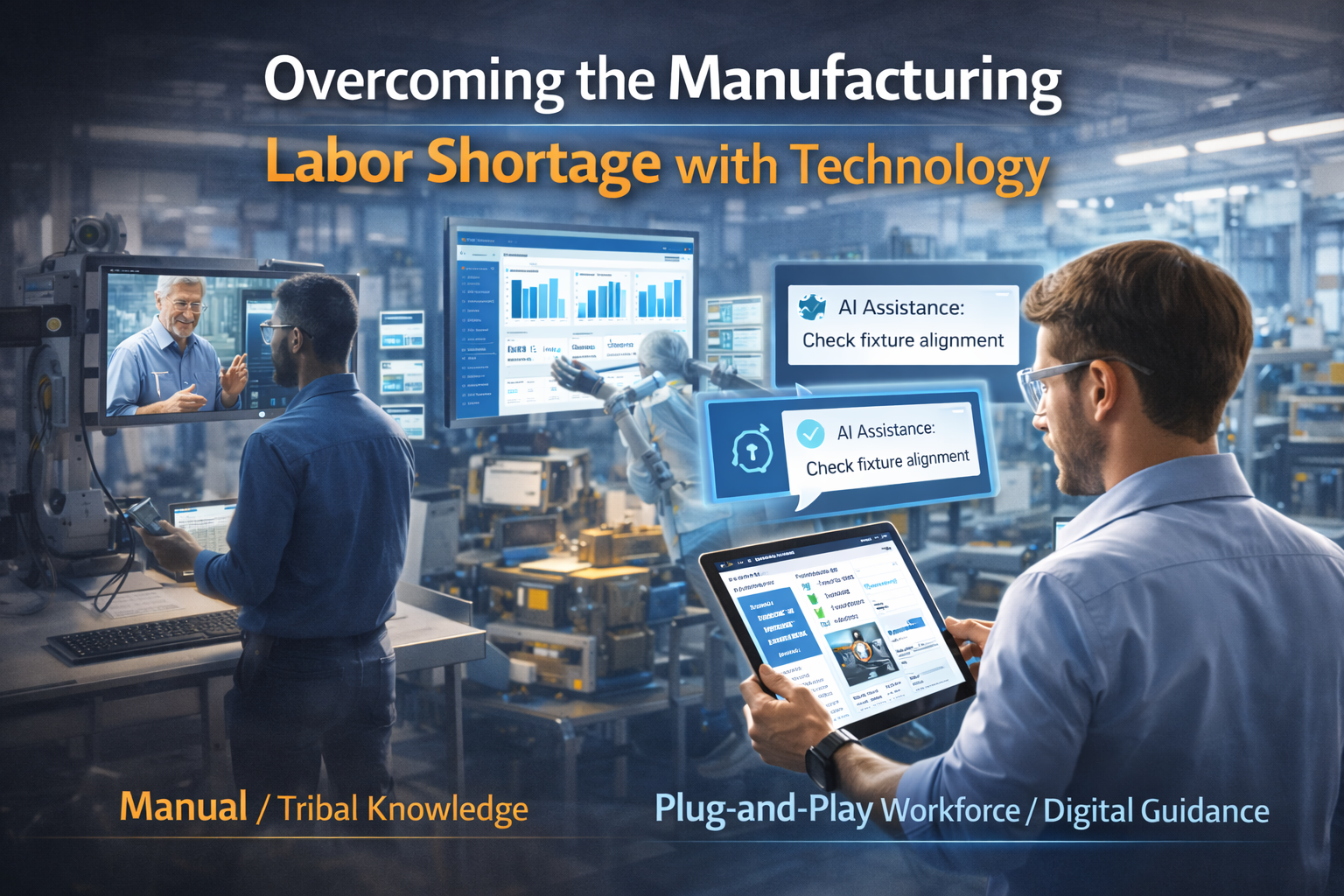
12 Mar How to Overcome the Manufacturing Labor Shortage with Technology
The manufacturing labor shortage is often described as a hiring problem. In reality, many manufacturers are facing a deeper issue: a competency crisis. Critical shop-floor knowledge lives in the minds of experienced operators who are nearing retirement. When those workers leave, decades of tribal knowledge disappear with them.
As a result, even when companies successfully hire new employees, it can take months before those workers become productive. Complex processes, undocumented procedures, and informal training methods slow down onboarding and make scaling the workforce extremely difficult.
This article explains how manufacturers can solve the manufacturing labor shortage by de-skilling complex processes using technology such as Epicor Connected Worker, digital work instructions, and AI-driven onboarding inside Epicor Kinetic.
By the end of this guide, you will understand how to:
- Reduce the impact of the manufacturing labor shortage without relying solely on hiring
- Capture tribal knowledge using digital work instructions
- Reduce manufacturing training time with step-by-step guided workflows
- Implement automated onboarding that prepares workers before Day 1
- Build a plug-and-play workforce where new hires perform like veterans immediately
Why the Manufacturing Labor Shortage Is Actually a Competency Crisis
The manufacturing labor shortage is not simply about the number of available workers. The real challenge is the loss of operational knowledge that experienced employees carry.
Tribal Knowledge Is a Hidden Risk
Many manufacturing operations rely on undocumented procedures. Veteran workers know exactly how to adjust machines, troubleshoot issues, and optimize processes. This knowledge often exists only in their experience rather than in formal documentation.
When these employees retire, that expertise disappears. New hires must relearn processes through trial and error, creating delays and costly mistakes.
Retiring Experts Create Operational Fragility
A single expert operator may hold the key knowledge for a specific machine, workflow, or product configuration. If that individual is unavailable, production can stall.
This creates a fragile system where the business depends heavily on specific people rather than standardized processes.
Hiring Alone Cannot Solve the Manufacturing Labor Shortage
Even when companies successfully recruit new workers, productivity remains low for months. Training cycles can take weeks or even years depending on the complexity of the operation.
The result is a cycle where businesses continuously hire but still struggle with operational capacity. The real solution requires capturing knowledge and simplifying work, not just adding headcount.
How De-Skilling Manufacturing Work Enables a Plug-and-Play Workforce
De-skilling manufacturing allows organizations to simplify complex work so that new employees can perform tasks quickly and consistently.
What De-Skilling Manufacturing Actually Means
De-skilling does not eliminate expertise. Instead, it translates expert knowledge into structured workflows that anyone can follow.
These workflows document best practices and convert complex processes into guided steps.
Standardized Workflows Replace Tribal Knowledge
When processes are standardized, new operators no longer depend on verbal instructions from experienced colleagues. Instead, they follow digital instructions embedded directly in the workflow.
This approach captures institutional knowledge permanently inside the organization.
Simplified Tasks Enable Workforce Scalability
When tasks become easier to execute, training time drops dramatically. A new employee can perform complex operations with confidence because the system guides them step by step.
The result is a plug-and-play workforce where productivity does not depend on years of experience.
Epicor Connected Worker and Acadia — The Technology Behind Digital Guidance
Epicor Connected Worker provides the digital infrastructure needed to support a modern shop-floor workforce.
What Epicor Connected Worker Does on the Shop Floor
Connected Worker tools deliver real-time guidance to operators directly at their workstation. Instructions appear digitally, allowing workers to follow the correct procedure without relying on memory or informal training.
This reduces errors, improves consistency, and accelerates learning.
Acadia Integration Enables Real-Time Digital Assistance
Epicor’s integration with Acadia expands these capabilities by enabling interactive, step-by-step operational guidance.
Operators receive contextual instructions based on the task they are performing. This transforms training into a continuous, real-time process rather than a separate classroom activity.
Where These Tools Fit Inside Epicor Kinetic
Within Epicor Kinetic, Connected Worker tools integrate directly with production workflows, job data, and operational instructions.
This integration ensures that workers always access the latest procedures, preventing outdated processes from spreading across the shop floor.
Digital Work Instructions That Reduce Manufacturing Training Time
Digital work instructions dramatically reduce the time required to train new manufacturing employees.
Step-by-Step Instructions Guide Operators
Instead of relying on printed manuals or verbal explanations, digital instructions present visual, step-by-step workflows.
These instructions may include:
- Images or diagrams
- Video demonstrations
- Task checklists
- Interactive guidance
Workers simply follow the steps on a screen while performing the task.
Visual Guidance Reduces Errors
Visual instructions remove ambiguity. Workers do not need to interpret complex written procedures because the system shows them exactly what to do.
This leads to fewer mistakes and faster learning.
Digital Instructions Deliver Immediate Operational Impact
Organizations implementing digital instructions often see measurable improvements quickly. Training cycles shrink, quality improves, and supervisors spend less time coaching new hires.
Most importantly, knowledge becomes permanently documented and accessible.
AI-Driven and Automated Onboarding in Epicor Kinetic
AI-driven onboarding is transforming how manufacturers train and prepare their workforce.
Onboarding Begins Before the Employee Arrives
Modern onboarding systems allow employees to begin learning before their first day on the job.
New hires can review workflows, safety procedures, and job responsibilities through digital systems that prepare them in advance.
Automated Onboarding Reduces Supervisor Workload
Traditional onboarding requires experienced employees to spend hours training new staff.
With automated onboarding, much of this knowledge transfer happens through digital guidance systems. Supervisors can focus on higher-value tasks instead of repeating the same training sessions.
AI Helps Interpret Complex Lists and Instructions
Advanced AI tools inside modern ERP platforms can assist workers by interpreting complex task lists, production instructions, and operational requirements.
This reduces the cognitive load on new employees and ensures they always receive the right guidance.
Turning the Manufacturing Labor Shortage Into a Competitive Advantage
Manufacturers that adopt Connected Worker technology can transform the manufacturing labor shortage from a limitation into a strategic advantage.
Workforce Flexibility Increases
Digital guidance systems allow employees to switch between tasks and workstations more easily. Workers no longer need years of experience to perform specialized jobs.
This creates a more flexible workforce that can adapt to production demand.
Digital Workforce Models Support Rapid Scaling
When processes are standardized and documented digitally, organizations can scale operations faster.
New facilities, production lines, or teams can follow the same digital workflows, ensuring consistent performance.
New Employees Become Productive on Day One
With guided workflows, digital instructions, and AI assistance, new hires can begin contributing immediately.
Instead of waiting months for productivity, companies gain workers who can operate effectively from their first shift.
Moving Beyond the Manufacturing Labor Shortage
The manufacturing labor shortage is not just a hiring challenge. It is a signal that traditional knowledge transfer methods are no longer sustainable.
Manufacturers that rely on tribal knowledge will struggle as experienced workers retire. Organizations that digitize expertise and simplify work will build resilient, scalable operations.
Technologies like Epicor Kinetic, Epicor Connected Worker, and digital work instructions make it possible to capture expertise, guide employees in real time, and dramatically reduce training time.
The result is a plug-and-play workforce where new employees can perform like experienced operators from day one.
If your organization wants to reduce training time, eliminate knowledge silos, and build a scalable workforce model, exploring Connected Worker technology within Epicor Kinetic is a powerful next step.
Scaled Solutions Group is here to guide you every step of the way.
For more information, contact Scaled Solutions Group at (866) 957-8419
Email info@scaledsolutionsgroup.com or Visit www.Get-Scaled.com.