


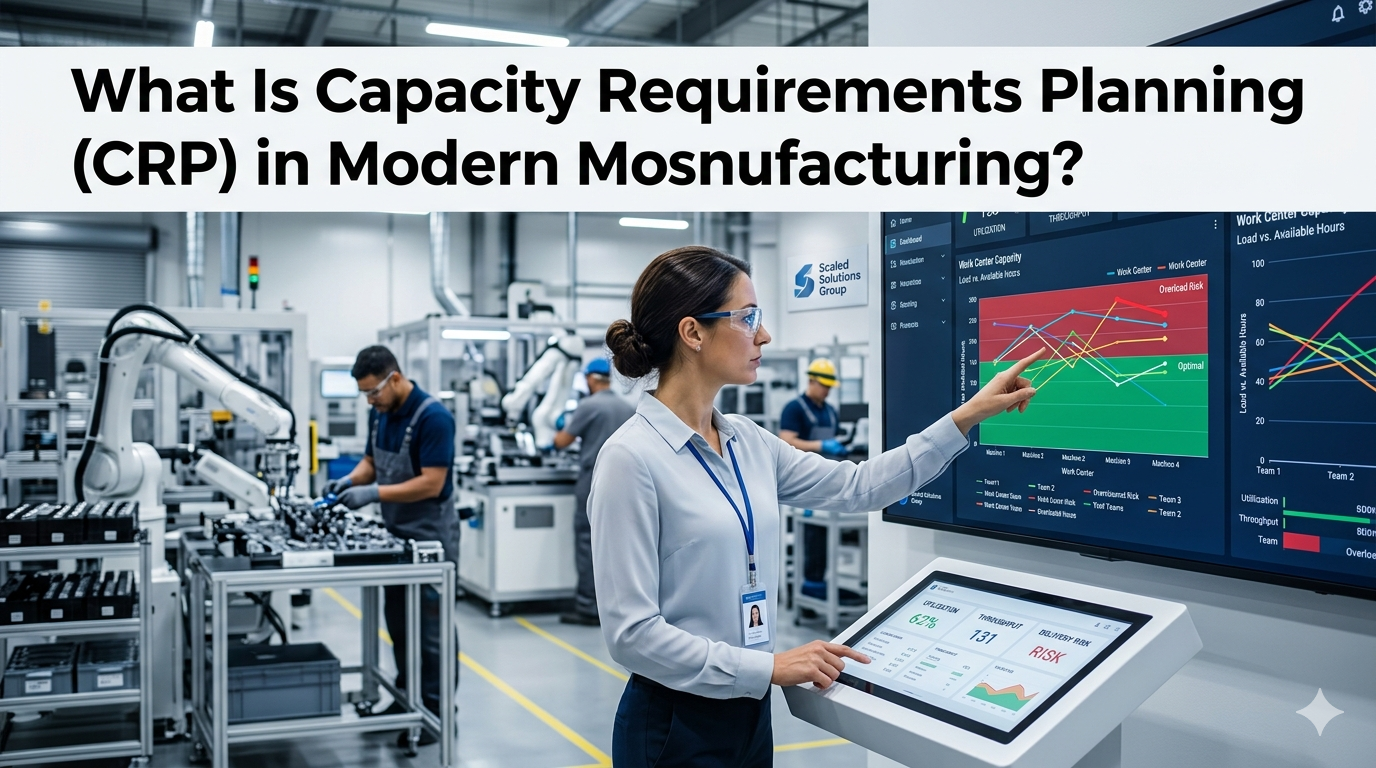
24 Apr What is Capacity Requirements Planning (CRP) in Modern Manufacturing?
What Is Capacity Requirements Planning (CRP) in Modern Manufacturing?
Manufacturers often release production orders on time but still miss delivery dates because machines, labor teams, or work centers lack available capacity. Material planning may be accurate, yet production still falls behind when resources are overloaded. This creates bottlenecks, overtime, expediting costs, and constant rescheduling.
Capacity Requirements Planning (CRP) in Modern Manufacturing solves this problem by comparing production demand with real available capacity. Instead of guessing whether the shop floor can handle scheduled work, CRP uses ERP data to validate workloads before delays happen.
This article explains how Capacity Requirements Planning (CRP) in Modern Manufacturing helps manufacturers create realistic schedules, prevent bottlenecks, and improve delivery performance.
This guide shows how CRP works, where it adds value, and how companies can use it to strengthen operations.
- Identify overloaded work centers before production starts
- Improve on-time delivery with realistic schedules
- Reduce overtime and expediting costs
- Increase labor and machine utilization
- Support smarter decisions with ERP planning data
What Is Capacity Requirements Planning (CRP) in Modern Manufacturing?
Capacity Requirements Planning (CRP) in Modern Manufacturing improves production accuracy by matching scheduled work with real machine and labor capacity. Many companies plan materials correctly but fail to verify whether production resources can complete the work on time.
CRP uses data from jobs, routings, work centers, and calendars to calculate required hours. It then compares those hours against available capacity. If demand exceeds capacity, planners receive early warnings and can adjust schedules before delays begin.
This gives manufacturers stronger control over production execution and more reliable customer commitments.
How CRP Works Inside an ERP System
Capacity Requirements Planning (CRP) in Modern Manufacturing works inside ERP systems by reviewing open jobs, planned orders, and routing steps. Each operation requires time on a machine or labor resource. The system totals those hours by date and compares them to available capacity.
What Data CRP Uses to Calculate Capacity
- Bills of Materials for production structure
- Routings for operation times
- Work centers for machines or departments
- Labor calendars for shift availability
- Job schedules for timing demand
- Setup and queue times for realistic planning
Why CRP Matters More in Modern Factories
Capacity Requirements Planning (CRP) in Modern Manufacturing matters more today because product variety, labor shortages, and tighter lead times create constant pressure. Spreadsheet planning no longer scales in fast-moving operations.
Why Capacity Requirements Planning (CRP) in Modern Manufacturing Prevents Bottlenecks
Capacity Requirements Planning (CRP) in Modern Manufacturing prevents bottlenecks by exposing overloads before production begins. This allows teams to solve issues early instead of reacting after schedules fail.
How Overloaded Work Centers Create Delays
Capacity Requirements Planning (CRP) in Modern Manufacturing reduces delays caused by overloaded resources. When one machine or department receives too much work, jobs wait in queue, downstream operations slow down, and due dates slip.
Why Early Visibility Improves Production Flow
Capacity Requirements Planning (CRP) in Modern Manufacturing improves flow because planners can see future constraints days or weeks in advance. They can reassign work, add shifts, or adjust priorities early.
Where Manufacturers Lose Money Without CRP
Capacity Requirements Planning (CRP) in Modern Manufacturing protects margins by reducing hidden costs such as overtime, premium freight, expediting fees, and lost customer confidence.
Who Should Use Capacity Requirements Planning (CRP) in Modern Manufacturing?
Capacity Requirements Planning (CRP) in Modern Manufacturing benefits organizations that need stronger scheduling control and higher delivery performance.
Which Industries Gain the Most Value
- Discrete manufacturing
- Industrial machinery
- Metal fabrication
- Automotive suppliers
- Electronics assembly
- Furniture manufacturing
- Food packaging operations
When Growing Manufacturers Need CRP
Capacity Requirements Planning (CRP) in Modern Manufacturing becomes essential when order volume rises, product complexity increases, or planners rely too heavily on spreadsheets.
Who Uses CRP Across Operations Teams
- Production planners
- Shop supervisors
- Purchasing teams
- Customer service teams
- Operations leaders
How Capacity Requirements Planning (CRP) in Modern Manufacturing Works Step by Step
Capacity Requirements Planning (CRP) in Modern Manufacturing improves execution by turning ERP data into realistic workload plans.
How Routings and Work Centers Drive Calculations
Capacity Requirements Planning (CRP) in Modern Manufacturing starts with routings. Each routing defines setup time, run time, and required resources. ERP systems multiply required time by order quantity.
How Load Is Compared to Available Hours
Capacity Requirements Planning (CRP) in Modern Manufacturing compares required load against available hours based on shifts, labor counts, machine uptime, and calendars.
How Planners Respond to Overload Conditions
- Move jobs to alternate work centers
- Split work across shifts
- Add overtime strategically
- Reschedule lower-priority orders
- Outsource selected operations
Where Capacity Requirements Planning (CRP) in Modern Manufacturing Connects with ERP Systems
Capacity Requirements Planning (CRP) in Modern Manufacturing creates the most value when fully integrated inside ERP systems.
How CRP Supports MRP and Production Scheduling
Capacity Requirements Planning (CRP) in Modern Manufacturing works alongside MRP. MRP determines material needs. CRP confirms whether the factory has enough capacity to build those materials on schedule.
Where Real-Time Data Improves Planning Accuracy
Capacity Requirements Planning (CRP) in Modern Manufacturing becomes stronger when job completions, downtime, absenteeism, and rush orders update in real time.
How ERP Dashboards Support Decisions
- Work center utilization
- Overload risk
- Job queue status
- Delivery risk
- Available capacity by date
Why Capacity Requirements Planning (CRP) in Modern Manufacturing Improves KPIs
Capacity Requirements Planning (CRP) in Modern Manufacturing improves measurable results by aligning demand with actual production capability.
How CRP Improves On-Time Delivery
Capacity Requirements Planning (CRP) in Modern Manufacturing improves on-time delivery because schedules become realistic and bottlenecks are managed earlier.
Why Utilization and Throughput Increase
Capacity Requirements Planning (CRP) in Modern Manufacturing increases utilization by balancing workloads across machines and labor resources.
Which Metrics Leaders Should Track
- On-time delivery rate
- Capacity utilization
- Throughput volume
- Overtime hours
- Queue time by work center
- Schedule adherence
How to Start Using Capacity Requirements Planning (CRP) in Modern Manufacturing
Capacity Requirements Planning (CRP) in Modern Manufacturing starts with strong data and disciplined planning processes.
How to Clean Routing and Labor Data
Capacity Requirements Planning (CRP) in Modern Manufacturing requires updated routings, realistic cycle times, accurate shift calendars, and dependable labor standards.
How to Train Planners and Supervisors
Capacity Requirements Planning (CRP) in Modern Manufacturing succeeds when teams understand overload alerts and follow clear scheduling rules.
How to Scale CRP for Long-Term Growth
Capacity Requirements Planning (CRP) in Modern Manufacturing scales when businesses continuously review constraints, refine standards, and use ERP insights to support growth.
Conclusion
Capacity Requirements Planning (CRP) in Modern Manufacturing helps manufacturers build schedules based on real capacity instead of assumptions. Companies that use CRP reduce bottlenecks, improve delivery performance, and gain stronger control over labor and machine resources.
The next step is to evaluate whether your ERP system supports effective CRP and whether your planning data is accurate enough to drive results.
Scaled Solutions Group is here to guide you every step of the way.