


03 Apr The Ultimate Guide to Managing Co-Parts in Manufacturing Production
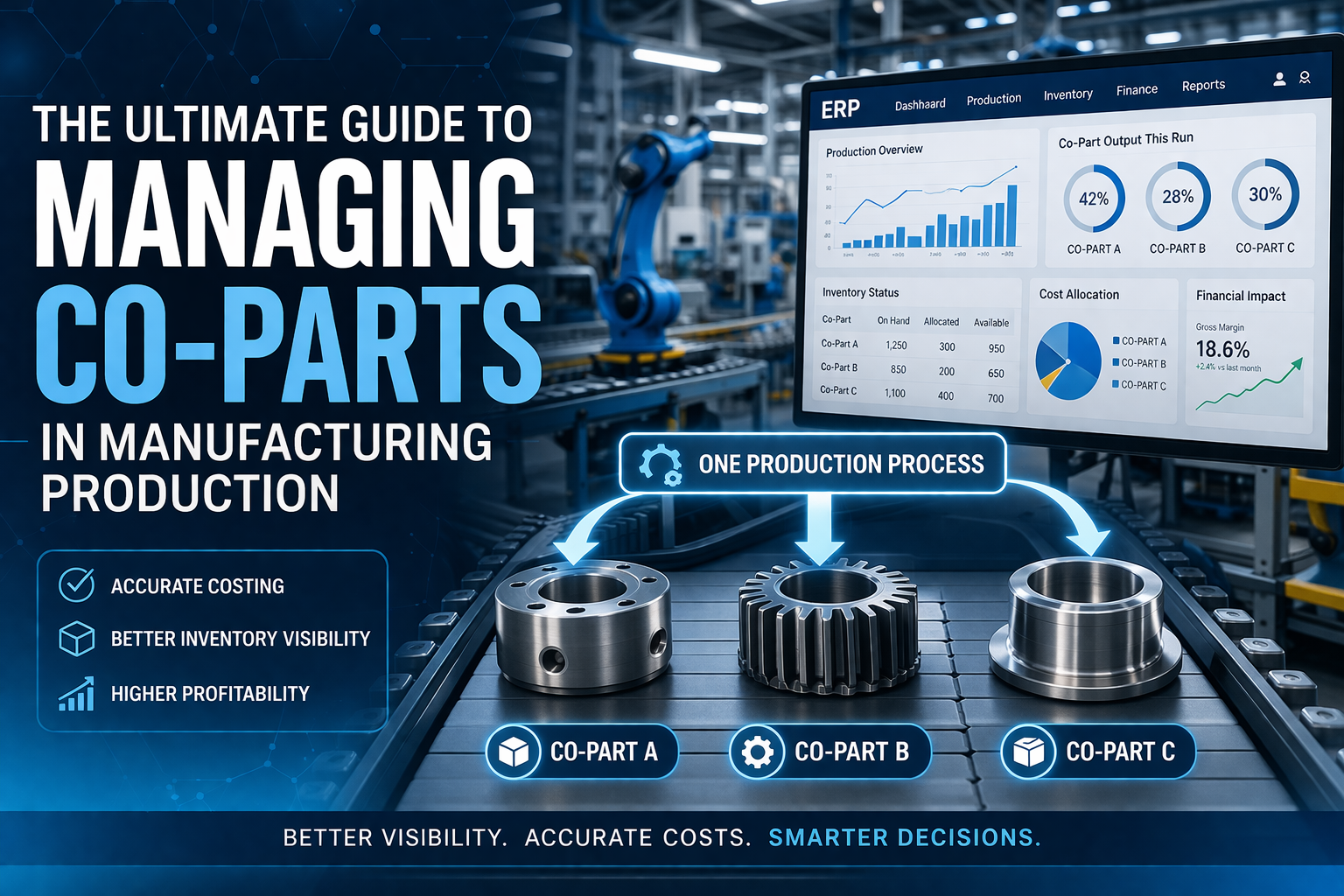
The Ultimate Guide to Managing Co-Parts in Manufacturing Production
Managing co-parts in manufacturing production is a persistent challenge for manufacturers producing multiple valuable outputs from a single process. Many businesses struggle with inaccurate cost allocation, poor inventory visibility, and disconnected workflows, which lead to margin erosion and operational inefficiencies.
This article explains how to manage co-parts in manufacturing production using ERP systems. This guide shows how to improve cost accuracy, streamline production workflows, and gain full control over inventory and financial data.
- Accurately allocate costs across multiple outputs from a single process
- Improve inventory visibility for co-produced items in real time
- Reduce production waste by tracking all usable outputs
- Enhance financial reporting with precise product costing
- Streamline ERP workflows for complex manufacturing environments
Managing Co-Parts in Manufacturing Production: What Are Co-Parts and Why They Matter
Managing co-parts in manufacturing production improves cost accuracy and operational visibility by ensuring every output from a production process gets properly tracked and valued. Businesses that define co-parts correctly reduce waste and eliminate costing errors.
Definition of Co-Parts vs By-Products
Co-parts are multiple primary outputs generated from a single production process, each with measurable economic value. By-products are secondary outputs with limited financial importance. Misclassifying co-parts as by-products distorts costing and reporting.
Real-World Manufacturing Examples
- Chemical processes producing multiple compounds
- Food production generating multiple sellable goods
- Metal refining creating different material grades
Business Impact of Poor Co-Part Management
Poor co-part management leads to incorrect pricing, inventory inaccuracies, unreliable financial reporting, and inefficient production decisions.
Managing Co-Parts in Manufacturing Production: Who Needs Co-Part Tracking in ERP Systems
Managing co-parts in manufacturing production aligns teams across departments by providing accurate and shared data through ERP systems. Multiple roles depend on co-part tracking to perform effectively.
Industries That Rely on Co-Part Production
- Food and beverage manufacturing
- Chemical production
- Metal and mining industries
- Pharmaceutical manufacturing
Roles Impacted Across the Organization
- Operations managers optimize production efficiency
- Inventory managers maintain accurate stock levels
- Finance teams ensure accurate cost allocation
- Production planners align output with demand
ERP Stakeholders and Decision-Makers
Executives, IT leaders, ERP consultants, and department heads must align to ensure successful co-part tracking implementation.
Managing Co-Parts in Manufacturing Production: Where ERP Systems Handle Co-Part Complexity
Managing co-parts in manufacturing production becomes efficient when businesses leverage the right modules within ERP systems. Integration across systems ensures accurate tracking and reporting.
Production Modules
Production modules manage multi-output processes by defining co-parts within production orders and tracking outputs in real time.
Inventory Management Systems
Inventory systems assign unique SKUs to each co-part and track quantities automatically, ensuring accurate stock control.
Cost Accounting and Financial Modules
Financial modules distribute costs across co-parts, ensuring accurate product costing and reliable financial reporting.
Managing Co-Parts in Manufacturing Production: When to Implement Co-Part Tracking Processes
Managing co-parts in manufacturing production becomes essential when operational complexity exceeds manual tracking capabilities. Businesses must act at the right time to avoid costly inefficiencies.
Signs Your Business Needs Co-Part Management
- Inconsistent costing across products
- Frequent inventory discrepancies
- Reliance on spreadsheets
- Unclear profit margins
Growth Stages Requiring ERP Optimization
As production scales, businesses must transition from manual processes to ERP-driven systems to maintain control and accuracy.
Transition from Manual to Automated Tracking
Automation reduces errors, improves efficiency, and provides real-time visibility into production and costing.
Managing Co-Parts in Manufacturing Production: Why Accurate Cost Allocation Drives Profitability
Managing co-parts in manufacturing production drives profitability by ensuring each output reflects its true production cost. Accurate allocation supports better pricing and margin analysis.
Cost Distribution Methods
- Percentage-based allocation
- Market value-based allocation
- Physical measurement allocation
Financial Accuracy and Reporting Benefits
Accurate costing improves financial reporting, supports compliance, and enables better decision-making.
Margin Improvement Strategies
Businesses can identify high-performing products, optimize processes, and adjust pricing strategies to increase profitability.
Managing Co-Parts in Manufacturing Production: How to Optimize Co-Part Workflows in ERP
Managing co-parts in manufacturing production improves efficiency when workflows are standardized and automated within ERP systems.
ERP Configuration Best Practices
- Define multi-output production orders
- Structure BOMs for co-parts
- Set automated cost allocation rules
Automation and Tracking Techniques
Automation ensures consistent data capture, reduces manual effort, and improves real-time tracking.
Integration with Inventory and Finance
Integrated systems ensure production, inventory, and financial data remain synchronized across the organization.
Managing Co-Parts in Manufacturing Production: How Leading ERP Systems Support Co-Part Management
Managing co-parts in manufacturing production becomes scalable with modern ERP capabilities designed for complex manufacturing environments.
Key ERP Features to Look For
- Multi-output production processing
- Automated cost splitting
- Real-time inventory tracking
- Batch and lot traceability
Examples of Co-Part Functionality
ERP systems automate output generation, cost allocation, and inventory updates within a single workflow.
Scalability and Customization
Flexible ERP systems allow businesses to adapt processes, scale operations, and maintain accuracy as complexity grows.
Take Control of Co-Part Management Today
Managing co-parts in manufacturing production is essential for achieving accurate costing, operational efficiency, and scalable growth. Businesses that implement structured ERP solutions gain visibility, improve decision-making, and strengthen profitability.
Scaled Solutions Group is here to guide you every step of the way.
Call (866) 957-8419
Email info@scaledsolutionsgroup.com
Visit www.Get-Scaled.com